WMD Modbox MKII packs two LFOs and a sample-and-hold into 8HP
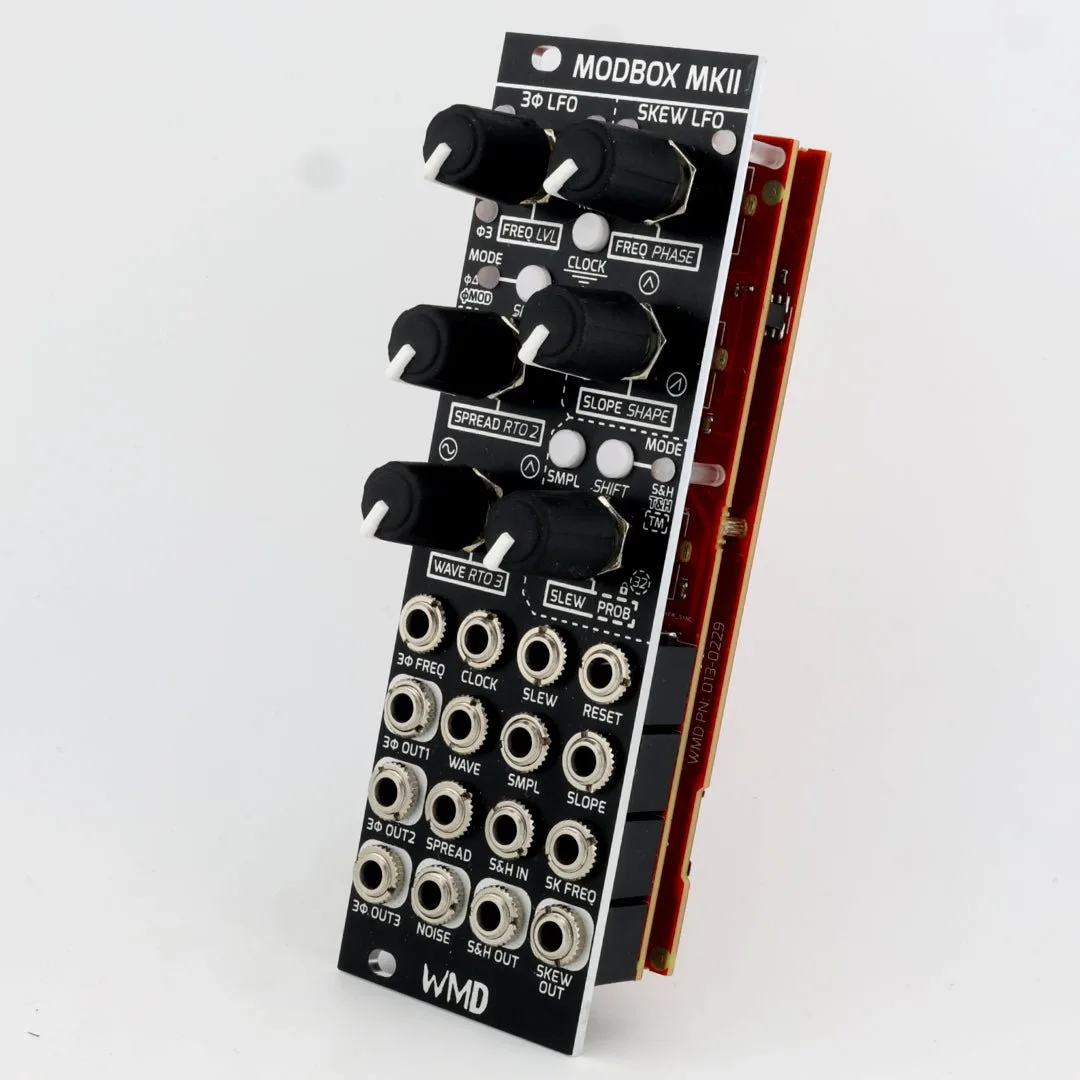
The Modbox MKII is on sale now for $279. WMD describes it as a multifunction module for related control voltages, clock-synced rhythmic movement and evolving random patterns.
It is a follow-up to the WMD/SSF Modbox and fits into 8HP of Eurorack space.
Randomness is wired in
Two connections are made inside the module, so no cable is needed for them. The analog noise generator feeds the sample-and-hold input. The pulse output of the Skew LFO feeds the trigger input. Modular players call this kind of default routing a normalled connection.
The result is that the LFO clocks the sampler, and the sampler reads noise. Random or looping voltages appear with no separate trigger source or noise source.
The digital sampler has three modes. Sample & Hold captures the input voltage when a trigger arrives. Track & Hold passes the input through as long as the gate is open, then freezes the last voltage once the gate shuts.
The third mode is Turing Machine. In this mode the sampled voltages are kept in a loop, and a probability knob decides if a fresh value replaces what the loop would repeat. Loop length can be set from one to 32 samples. At one end that gives ever-changing values, at the other repeating or reversing sequences.
Two LFOs that also reach audio rate
An LFO is a low-frequency oscillator, normally used to move other parameters rather than to be heard. Here both oscillators track 1V/octave and can run at audio rates, so either can serve as a sound source too. Both accept clock synchronization.
The Skew LFO's waveform moves between sawtooth, triangle and ramp shapes. A slope control adjusts the transition between them. A shape function separately reshapes the curve, from exponential to logarithmic with linear between.
The Three Phase LFO produces three related outputs. Phase Offset shifts the phase between them, and Phase Modulation adds cascading phase distortion. Frequency Spread changes the second and third outputs relative to the first: the second can reach eight times the base frequency and the third can drop to one-eighth of it.
A waveform control morphs those outputs continuously through sawtooth, sine, triangle and ramp. The second and third outputs also have independent frequency ratios.
Sync, size and settings
Clock and reset inputs keep the LFOs in step with the rest of a system. Ratios range from a 1:512 division to a 4:1 multiplication, and the synchronization and reset behavior can be chosen.
The listed depth is 38mm, including cables. Settings are saved after one minute without activity on the Shift and Mode controls. Firmware can be updated in the field.
Our view
The built-in noise and pulse routing is the detail that decides whether this module earns its slot. It trades some patching freedom for speed, since the sampler is already clocked and fed out of the box. How the Turing Machine mode sounds in a full patch is a question for hands-on use.
Source: WMD