Mntra's Living Sky moves spatial mixing and reverb to the GPU
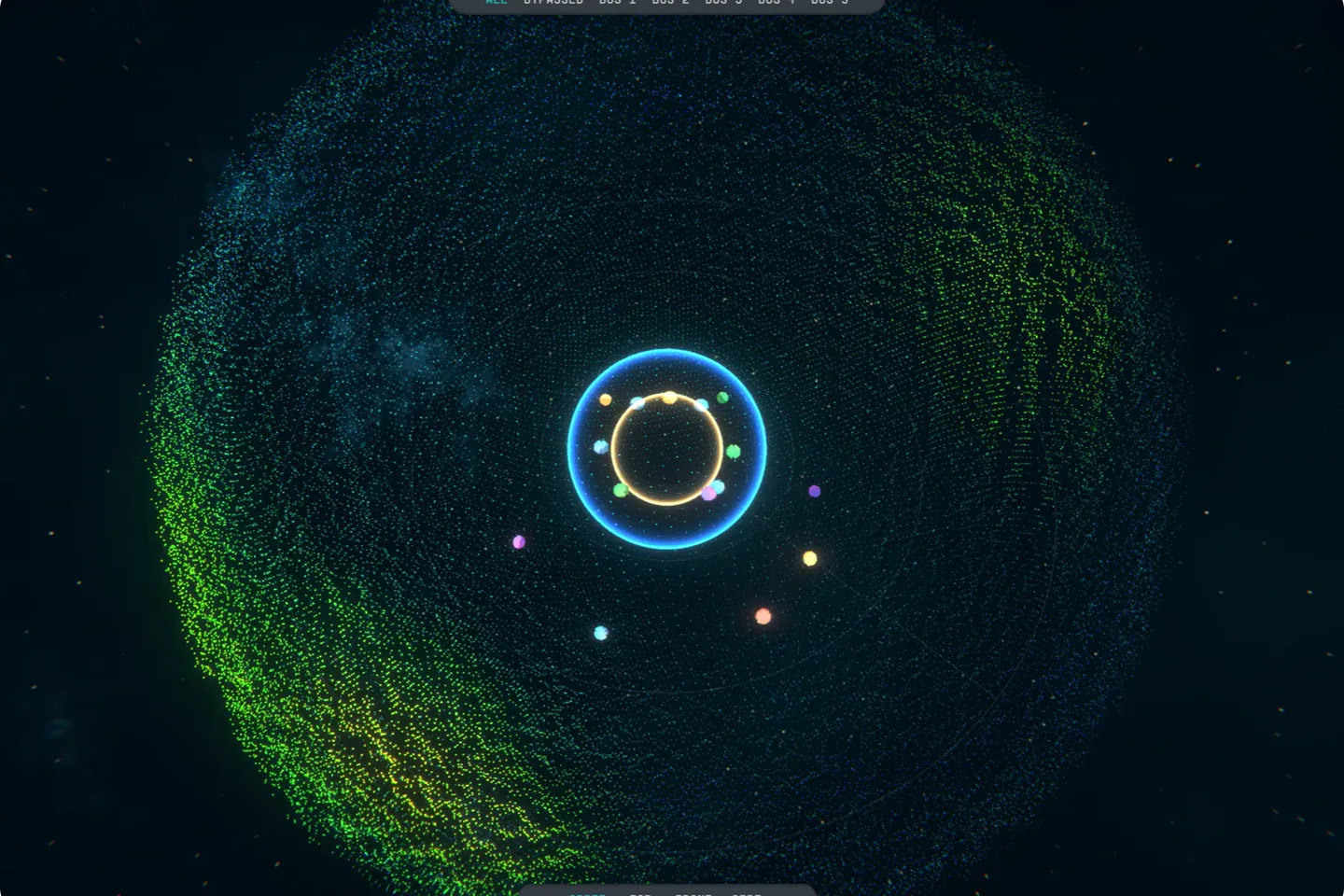
Mntra Instruments is selling Living Sky for $799, and a free 30-day trial is open to anyone who wants to check the claims first. The plug-in combines a 3D spatial mixer with a convolution reverb and leaves the processing to the graphics card.
Trial limits and first impressions
The trial is cut down. You get four sources, stereo or binaural output, and only a selection of the spaces.
The first reactions come from people who work in immersive audio. Justin Gray is a Toronto engineer who has mixed over 3,000 songs in Dolby Atmos, and his Atmos album Immersed won a Grammy. He says he has "never heard anything like it in my life".
Matt Anderson reviewed the plug-in for Tape Op after more than a month of work on Dolby Atmos projects. His verdict: "almost a whole system in and of itself". He liked the multi-mic support, which let him pass a 7.0.4 microphone array through the plug-in's spaces.
His one caveat is the learning curve. The tool is deep, and mastering it takes time.
Why the GPU
A convolution reverb normally borrows the acoustics of a place from a recording called an impulse response. Living Sky does not stop at one. The graphics card runs hundreds of convolutions live, and position, acoustics and movement are treated as one problem.
The plug-in was built with GPU Audio and Outer Echo. Mntra first announced it in January 2024. It targets music, film, games and immersive audio.
Spaces and sources
The main Space Collection has more than 120 responses, all recorded on site with higher-order Ambisonics gear and microphone arrays of Mntra's own. The Lese Audio Space Collection is different: its spaces are modelled virtually.
One instance can hold up to 64 sources. Each gets distance, elevation, azimuth and width controls. Five reverb buses are available, each with room for three spaces. Mntra also lists 32 modulation slots and an Aura send with Drift and Flux controls.
Sources can also be placed and moved in a separate 3D Control App. Anderson praised it because it displays where each source sits and how much energy is in the space, much like Dolby's Atmos Renderer.
Formats, outputs and routing
Everything is processed internally in Ambisonics. That lets you move one mix between outputs, from stereo to 22.2, with no rebuild. The list of outputs also includes binaural, 7.1.2, 9.1.6 and fifth-order Ambisonics.
OSC head tracking is supported for binaural monitoring. Plug-in formats are VST3, AU and AAX, on macOS and Windows, running on the GPU Audio engine.
One routing condition applies. To send several tracks into a single instance, you need a DAW that handles spatial audio; Logic Pro is the example given.
Source: Attack Magazine