RME ADI-2/4 Pro EX brings new converters and lockable USB-C
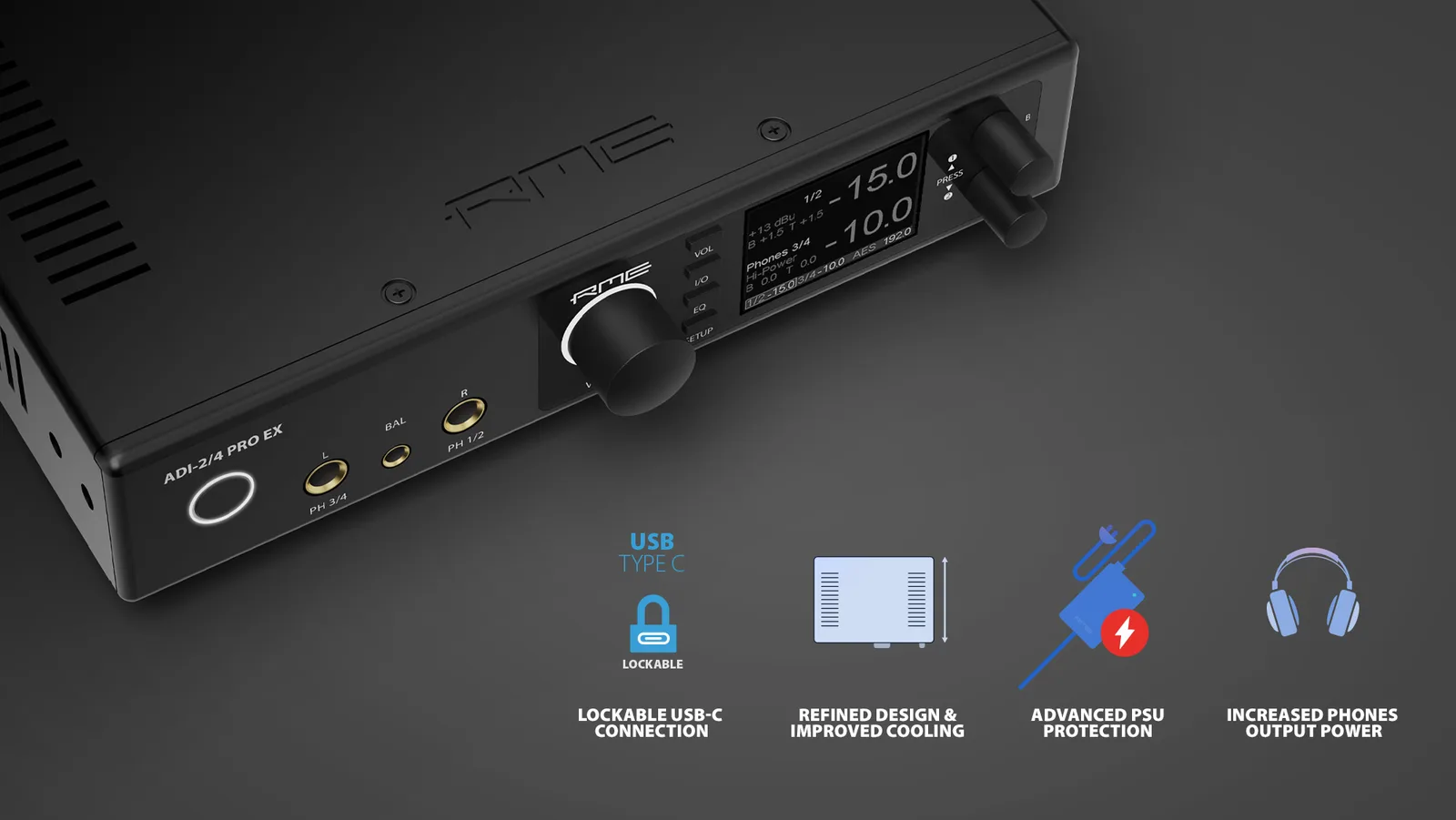
RME has released the ADI-2/4 Pro EX, an update to its flagship converter and headphone amplifier. The unit is available now at $2,999, or £2,300 including VAT in the UK.
The redesign starts with the converters. RME names the ES9823Pro for analogue-to-digital conversion and the ES9039Q2M for digital-to-analogue. It lists improved signal-to-noise and THD+N figures for both stages and a signal-to-noise ratio of up to 127 dBA. Sample rates reach 768 kHz.
The housing is a half-rack, 1U enclosure with two analogue inputs and four analogue outputs. As a computer interface it works in a stereo mode with two inputs and two outputs, or in a multichannel mode with six inputs and eight outputs.
Clock, connection and protection
The internal clock is now calibrated at the factory to ±1 ppm under SteadyClock EX. Users can shift the sampling rate by ±50 ppm in steps of 0.1 ppm. That lets the unit sync with other equipment without a word clock connection.
A lockable USB-C connector replaces the previous USB port. It stays USB 2.0 compatible and class compliant under UAC 2.0, so iOS, macOS, Linux and Windows 10 (since version 1709) recognise it without extra drivers. A 1.8 m USB-C cable is in the box, and the external power supply has a lockable connector, so the unit can run from a battery.
Each headphone output has its own DC protection circuit. A new fuse-less power supply protection detects reversed polarity and overvoltage. There is also a dedicated ground terminal for turntables, and the unit fits the new RM19-III rackmount adapter.
Headphones and inputs
Two headphone amplifiers remain. True Balanced Mode supports four-cable headphones, with a Pentaconn connector and dual quarter-inch TRS sockets. ADAT channels 3/4 can now be chosen directly as the headphone source.
The analogue inputs reach lower reference levels, down to -35 dBu, so dynamic microphones can be connected directly. RIAA equalisation is available in Line mode, and the balanced input impedance can be set to 94 kΩ or 47 kΩ.
Onboard DSP provides dual five-band EQ for the left and right channels, crossfeed speaker simulation, Mid-Side processing, selectable D-A filters, and loudness and stereo-width adjustment.
Source: RME