Audient puts room correction inside its iD Mk3 interfaces
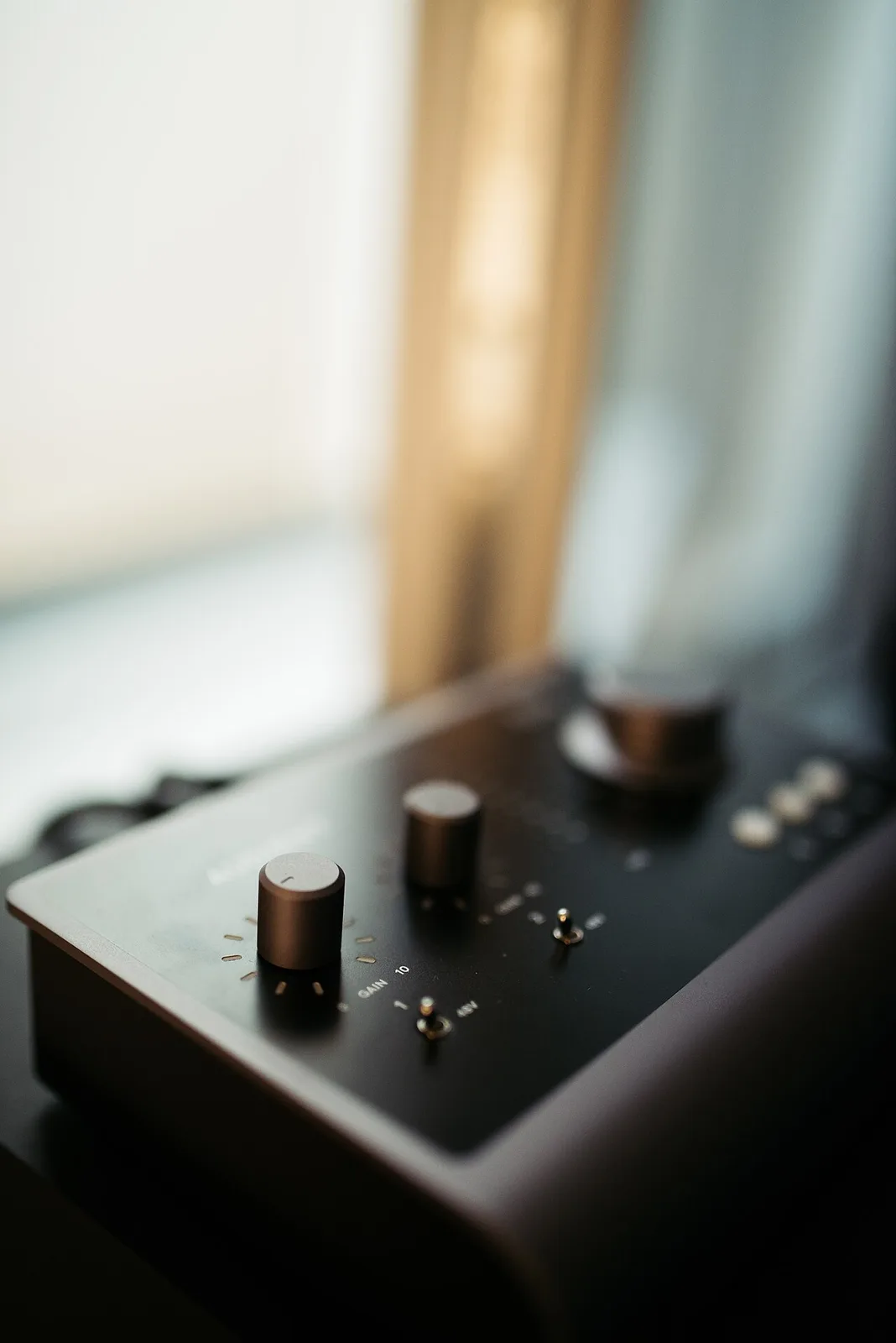
Audient has built room correction into the hardware of its compact desktop interfaces. The third-generation iD range has four models, and each one comes with a tool called RoomTune.
What sits in front of the converters
All four units use a front end derived from the ASP8024-HE console. The preamps follow the same discrete Class-A design as that console and give 75dB of clean gain.
The range also gets an Analogue Tone Suite, four tools that shape the signal before it reaches the recording software. Orbit is an analogue circuit whose variable impedance control changes how a microphone responds to the preamp. HMX adds harmonic saturation with a custom MOSFET. LIFT boosts the highs and suits vocals particularly well. GLOW combines HMX and LIFT, which gives saturation in the low mids and sheen in the highs.
Conversion is 32-bit with 128dB of dynamic range, and sample rates go up to 192kHz. Onboard DSP, a chip dedicated to audio processing, handles EQ, compression and reverb with zero latency. Full performance comes over USB-C bus power, so no AC adapter is needed. The units run on Mac and Windows.
RoomTune and its limits
Room correction tries to reduce the way a room colours the sound of studio monitors. RoomTune is Audient's own software for that job. It is included with every iD Mk3 interface. The calibrated profiles are stored on the interface, and its DSP runs them.
Calibration needs the RM1 Reference Microphone. It ships with the iD2+ and iD4+. Owners of the iD1 and iD2 can add it as an option, priced at $54.99, £39.99 or €49.99.
The first version is narrow. It corrects the main stereo monitor outputs only. Audient says it plans multiple calibration profiles and headphone correction for later updates.
A new naming scheme
The names now count mic preamps, and the old ones map onto new ones: the iD4 is now the iD1, the iD14 is the iD2, the iD24 is the iD2+ and the iD44 is the iD4+. The four units share one core design and differ only in the number of inputs and outputs.
The iD1 has two inputs and two outputs. It offers one console mic preamp and a JFET instrument input, and both can be used at the same time.
The iD2 has 10 inputs and 6 outputs. It has two preamps, ADAT expansion for eight more inputs and monitor control with two speaker outputs. The iD2+ has 10 inputs and 14 outputs, two preamps and two balanced hardware inserts on channels 1 and 2. Its ADAT connection carries eight channels in and out.
At the top, the iD4+ has 20 inputs and 24 outputs, four preamps and two instrument inputs. It adds two inserts, 16 ADAT channels and two independent headphone amplifiers with up to four cue mixes. The new interfaces are available now.
Source: Sound On Sound